Growing health and effectiveness

A blog centered around The Addington Method, leadership, culture, organizational clarity, faith issues, teams, Emotional Intelligence, personal growth, dysfunctional and healthy leaders, boards and governance, church boards, organizational and congregational cultures, staff alignment, intentional results and missions.

Thursday, March 10, 2022

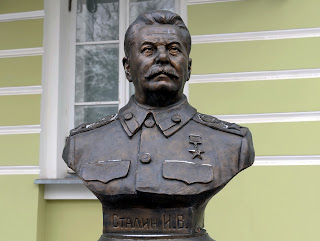
Putin is the new Stalin


I have come to the conclusion, with considerable unhappiness that Putin is the new Stalin and just as President Xi is taking China back to the days of Mao, so Putin is taking Russia back to the days of Stalin. And in both cases, those were dark days where many suffered unjustly. Why do I suggest this. Consider the following which come directly out of Stalin's playbook.


Those who disagreed with Stalin paid for that disagreement with their lives, imprisonment (Siberia) or torture. The same is happening under Putin. He has killed his enemies in Russia and outside of Russia, has imprisoned thousands and even a statement of opposition to the current war can get you fifteen years in ugly Russian prisons. And, like Stalin he seems to care not what the rest of the world thinks.


Putin, like Stalin dresses actions with a veneer of judicial "fairness." Time and again, charges against his political enemies have been decided before a trial which is simply window dressing.


Subordinates would not tell Stalin what they really thought for fear of their jobs or lives. Neither does it seem that Putin's people are willing to speak truthfully with him if it means disagreeing with him.


Stalin was willing to kill people indiscriminately to accomplish his purposes without an ounce of remorse. He starved the Ukraine killing millions, and shot those who got in his way, or that he thought might get in his way. Putin used these kinds of tactics in Chechnya, Syria and now in Ukraine. People's deaths don't bother him. Shelling hospitals and schools and residential areas is a war tactic. Millions of refugees does not phase him. He will do whatever he needs to in order to accomplish his ends. Without apology and without conscience. There is a ruthlessness to both men that defies logic or humanity.


Putin, like Stalin is a liar to the core of his being. Both believe that the more you say something untrue the more the population will embrace the lie. And in many cases that is what happens. It is impossible to believe anything that Putin says and the same was true of Stalin.


Stalin tightly controlled the media in order to ensure that his party line was the one line that was communicated. Putin does the same thing and has essentially shut down any independent media in the country by passing laws that lie about the war or the country or its leaders. Of course the definition of a lie is whatever Putin does not want to hear.


Putin sees himself as a Tsar - one who is all powerful, always has the final say and whom no one can cross. While Stalin would not have thought of himself that way, he cultivated the same result by ruthlessly eliminating any and all rivals. Putin, like Stalin is consumed by his legacy and power.


Both men were and are deeply suspicious of people of faith. Stalin closed the churches and imprisoned or killed pastors. Putin has co-opted the Russian Orthodox Church for his own political purposes and has made the lives of evangelicals very difficult. The Orthodox church has made a Faustian bargain with Putin and benefits monetarily from that bargain (or did till the ruble became worthless). Evangelical Christians who will not make such a bargain are harassed, denied building permits or the ability to minister as they desire.


Both Stalin and Putin are characterized by an utter lack of any sense of righteousness. For them it does not exist. What matters is raw unadulterated power. Period. Anything or anyone that gets in the way of that power or their personal will can be sacrificed at will.


What characterizes both men is the utter disregard of what the world thinks of them. Apart from wanting to be feared, they are willing to engage in war crimes, killings, corrupted judicial proceedings and blunt force to get their way regardless of world opinion. It takes a very cold and ruthless heart to go there but that is what we are dealing with.




Moving from places of anxiety to places of peace


“Do not be anxious about anything, but in every situation, by prayer and petition, with thanksgiving, present your requests to God. And the peace of God, which transcends all understanding, will guard your hearts and your minds in Christ Jesus.” Philippians 4:6-7


Anxiety and worry are a part of the human condition. It is easy for someone to say, you shouldn’t worry, but I don’t know anyone who can go through the situations of life without anxiety and worry. We are finite human beings, and the fact that we cannot know the end from the beginning makes worry a part of life.


That being said, moving from worry to faith, from anxiety to dependence on God, is one of the journeys that Jesus invites us on. He does not want us to live with worry and anxiety but to live with faith and trust and allow our concerns to be carried by Him and not by us. 


I find it interesting that the words “do not be afraid” are repeated 365 times in the Bible, once for every day of the year. We need to hear these words every day because we need them daily. Scripture reminds us not to worry about having enough money for tomorrow because God looks after His own. We are told not to worry about the future because each day has enough worries of its own, and He carries them for us. We are told not to be anxious but to give our cares to Him.


There is an antidote for worry, and that is prayer. As Paul says in Philippians 4:6-7, “Do not be anxious about anything, but in every situation, by prayer and petition, with thanksgiving, present your requests to God. And the peace of God, which transcends all understanding, will guard your hearts and your minds in Christ Jesus.” 


We are invited in all situations, in all circumstances to bring our anxieties to Jesus in prayer and petition, and present our requests to God. Interestingly, Paul says that we should do this with thanksgiving. Why Thanksgiving? Because He is capable and able to intercede in our situation and carry our worries for us. And the exchange is this: We give him our anxieties, and he gives to us the peace of God which transcends all understanding. And that peace will guard our hearts and our minds - where anxiety and worries live - in Christ Jesus. I’ll take that exchange any day.


Some years ago, I was on a flight from Bangkok to the United States, and just as the plane was ready to take off at the end of the runway, the flight attendant saw that I was sick and had lapsed into unconsciousness. I woke up with my 20-year-old son kneeling beside me, and I heard the pilot announce that we were returning to the gate for a medical emergency. I asked my son if that was me, and he said, “yes, dad.” A few minutes later, we arrived at an unknown hospital to figure out what was wrong. 


They thought I had suffered a seizure, but there was no evidence of this with a brain scan. But over the course of the day, I went from sick to very sick to needing to be intubated in the ICU. A year earlier, I was intubated for a month in a coma in the United States for multiple organ failure and MRSA pneumonia and never should have survived. It was a 45-day hospital stay that took me years to recover from. Now a year later, still in recovery, I found myself in the same situation in a foreign country: organs shutting down, massive pneumonia, and knowing that my odds were not good.


I asked the doctor if they were going to put me into a coma like the year before, and he said no. “We will put you under to intubate you, and then you will be awake.” So, an hour later, I found myself awake, with a garden hose contraption down my throat, hooked up to some 15 pumps of various kinds and a breathing machine, and massive, unbelievable pain.


That first night I contemplated my odds. They were not good. I asked God to remove my pain, but that didn’t work. And then, as I reflected, my mind kept going back to a message I had preached about Peter getting out of the boat and walking toward Jesus and Jesus saying to him. Do not be afraid. And I asked God to take away my fear of death and the fear of the unknown. It was a gigantic struggle that first night, and it was repeated again and again as it would be 14 days before I was off the ventilator. But amazingly, God did exactly what He promised, and I traded my fear and anxiety for a supernatural peace that only God can give. 


The pain did not lessen. In Thailand, they didn’t provide pain medication, and with massive pneumonia, you feel like you are breathing through mud. Every hour they would disconnect the breathing machine, bag me to breathe, and vacuum out my lungs so that I could breathe again freely. That experience was like having a heart attack, and every hour felt like twenty-four hours of terrible pain for fourteen days. But, I traded fear for peace because of God’s promise. I realized that the greatest gift is when we come to the end of all of our resources, and all we have left is Him. Then we realize that He is all that we need.


Jesus is inviting you today to trade your worries and anxieties for His peace. That takes place as we bring our concerns to him daily in prayer and petition - with thanksgiving. And He can take those anxieties on Himself and leave us with supernatural peace. So whatever your anxieties are today, He invites you to give them to Him.


Father, I freely admit that I need more of your peace and less of my worry and anxiety. I give you my deepest fears and anxieties today and ask that you fill me with your peace that passes all understanding. Thank you for your goodness to me and your desire to carry my burdens yourself. Amen.


The question for today: What worries and anxieties do I need to give to Jesus in exchange for His supernatural peace.