Growing health and effectiveness

A blog centered around The Addington Method, leadership, culture, organizational clarity, faith issues, teams, Emotional Intelligence, personal growth, dysfunctional and healthy leaders, boards and governance, church boards, organizational and congregational cultures, staff alignment, intentional results and missions.

Wednesday, March 2, 2011

Is your church more missional or institutional?


Every church falls somewhere on the continuum between missional and institutional. However, the fact that the vast majority of churches in the United States are either plateaued or in decline would indicate that there are far more institutional churches than missional.  One of the primary jobs of leaders is to keep pushing the church in missional directions and resist the temptation to move into the comfort zone of the institutional.

Institutional churches place an emphasis on organization and status quo at the expense of other factors. Common characteristics of institutional churches include the following:
  • A focus on themselves
  • Love of meetings, boards, committees and bureaucracy
  • Guarding of the status quo
  • Resistance to innovation
  • Inward rather than outward focused
  • Infighting and power struggles
  • Live in the comfort zone
  • Few spiritual conversions
  • Threatened by strong missional leadership
  • Change resistant
  • Lots of rules
  • Self reliant

Most sadly, they usually live with the allusion that all is well!

Missional churches on the other hand have a deep and abiding commitment to the great commission (more believers and better believers) and that mission always comes first and is the driving force of all energy, direction, funding and personnel. Their characteristics are very different from the institutional church:  
  • Leadership is about the future. They celebrate the past but are always reinventing the future whereas institutional churches worship the past and want the future to look like the past.
  • Understand the mission of the church: more believers, better believers
  • Are outward focused
  • Flexible in methodology
  • Empower everyone to be involved in ministry in line with gifting and wiring
  • Regularly innovate
  • Have little bureaucracy: The structure serves the mission
  • Have great trust
  •  See significant fruit
  • Have an attitude of “Whatever it takes.”
  • Few rules
  • Allow leaders to lead
  • Keep the main thing the main thing all the time
  • Spirit empowered

When you think about it, Jesus was all about mission while the Pharisees were all about institution. It makes one think...

Tuesday, March 1, 2011

The power of our thinking

This last weekend I had the privilege of interacting with a great group of pastors and church leaders from Texas and Oklahoma. In our dialogue session on missional and empowered churches the question was asked about overcoming barriers to growth - as most of these congregations were three hundred or less. My answer to them may have surprised them but I believe it goes to a principle that applies to both churches and ministry organizations that desire to see their influence and ministry grow.

Perhaps the biggest barrier to our growth is how we think about ourselves. A small church often thinks like a small church. A mom and pop ministry organization often thinks like a mom and pop ministry organization. That very mindset is the very thing that often keeps us from going to the next level. To get to the next level, one must think like one would think - and therefore act - at that next level.

Take a wonderful ministry that I interact with from time to time. It is still in the entrepreneurial start up phase characterized by low levels of salary for employees, lack of strong internal infrastructure or ministry stability and a board that constantly gets into management decisions. Its very internal structure is designed to keep it where it is and prevent it from growing into a more disciplined, stable organization. They think small, act small even though they want the opposite.
 
What this ministry needs to do to grow to the next level is to start to act like a ministry would act at the next level. It is counterintuitive but to grow one must act as if the organization were larger - and often it will catch up!

This is equally true with churches who desire to get to the next level. If you are a church of 200, ask the question: "What does a successful church of 400 look like and what are they doing differently than us?" Often it goes to the quality of what they do and a mindset that is more external than internal. How the leadership thinks and acts is also probably different. Leadership that is locked into the minutia of who locks the church and who can use the gym do not have the time to focus on the very issues that will help them move to the next level.

The bottom line is that growing ministries have leaders who are thinking ahead of the current size of their ministry. They know where they are but they think like a larger ministry and make their own decisions accordingly. While there are many barriers that can hold us back it is this unseen barrier that may be the most important to pay attention to. 

Monday, February 28, 2011

Unattended baggage


All of us have areas of our lives that don’t fully conform to God’s plan for us. It is the gap between our knowledge of God and our daily practice and the fact that we are even aware of that gap is the ministry of the Holy Spirit who gently nudges us toward conformity to Christ.

Often the reason we have not confronted these areas of our lives is that we have not had the courage to face the issue – or the courage to get serious about resolving it. Courage is the operative word because admitting to ourselves that our unattended baggage must be faced, named for what it is and resolved takes real personal courage and significant resolve. It takes courage to look sin or areas of great deficiency in the eye, strip away our rationalizations and avoidance techniques, name it for what it is and confront it head on.

These issues may be health, financial, moral, relational, ethical or spiritual. They may be public issues or private issues. Once we are aware of our unattended baggage, it dogs our conscience and thinking until we agree with the Holy Spirit that it is time for us to resolve it.

Knowing and resolving are not the same. The first is a gift of the Spirit to get our attention. The second is courageous resolve to bring that area of our lives under the supremacy of Christ by addressing it. And no effort to move closer to God’s best for our lives goes unnoticed in the heavens and the same Spirit that brings unattended baggage to our attention gives us the ability to start dealing with it. It is then our responsibility to develop a plan by which we are going to deal with our issue. A plan is more than good intentions: it has concrete steps we are going to take coupled with evaluation points. And, hopefully a friend who can pray for you and encourage you in the process.

As Christian leaders we have even greater responsibility to deal with unattended baggage since we call those we lead to do the same. Our personal credibility is built on life authenticity and courageous engagement with our own issues.

Saturday, February 26, 2011

Sayed Mossa Released

World Magazine is reporting that Sayed Mossa - previous blog - Dying for his faith - has been released and sent into exile. We rejoice with his family. It was the international Christian community which put pressure on the Afghan government.

See the report.

Friday, February 25, 2011

Dying for his faith


This is a portion of a letter to believers around the world that was written from a prison in Kabul. Sayed Mossa is a Red Cross worker from Afghanistan that has been condemned to death by the Afghan courts for converting to Christianity. In spite of the fact that Afghanistan is a signatory to the Universal Declaration of Human Rights and its religious freedom clause (Clause 18) and the Afghan constitution that promises to uphold this right, Sayed has been condemned to death without legal counsel and in spite of pleas from governments around the world. His only crime is accepting Christ as his savior.

Please pray for Sayed and his family. May this be a reminder that across our globe there are believers who die for their faith weekly and as Sayed says in his letter - are willing to make a public testimony for their faith! This is also a reminder of the stakes in the current upheaval in the Middle East. Afghanistan claims to be a democracy yet it does not uphold the rights of the minority - in this case believers in Jesus. This scenario has already been played out in Gaza under Hamas, Iraq where Christians have been driven out in droves and numerous countries where it is a crime to convert from Islam to Christianity.

As believers in the west who have amazing religious freedom, we ought to pray daily for those around the world whose life is in danger daily because of their faith.

You can read Sayed's story on these sites:

International Christian Concern

World Magazine

National Review Online

Thursday, February 24, 2011

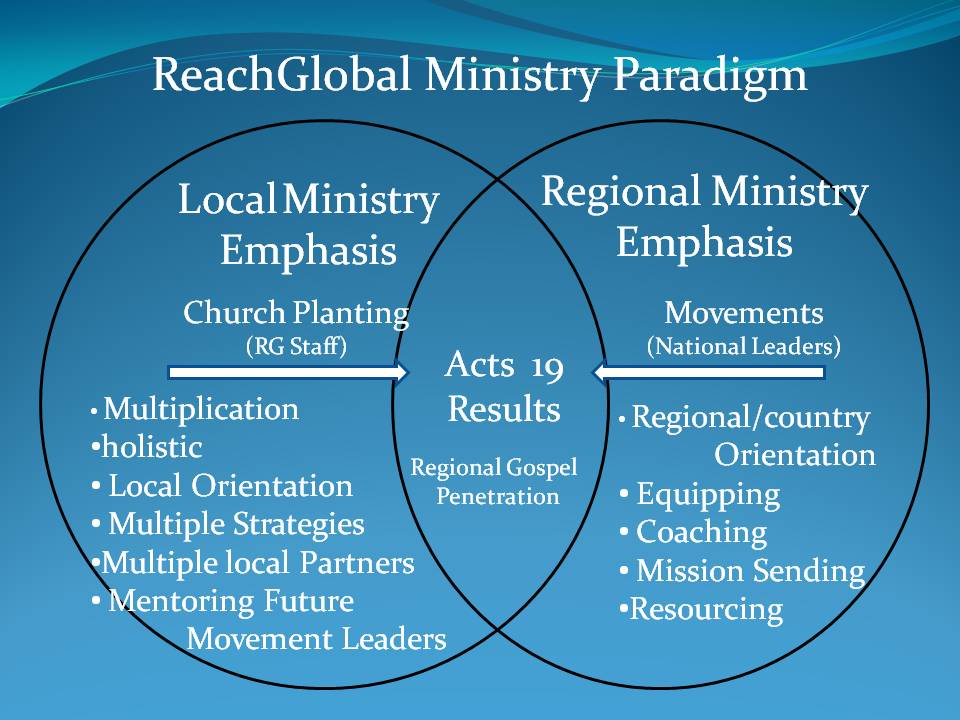
Missions in the 21st Century: Two Circles, one goal


Missions has changed significantly since I grew up as an MK in Hong Kong in the sixties. My parents would leave for a term of four to five years to a place they had never been to before. Instead of Skype and phone calls there would be a weekly letter home. Our supporting churches knew only what we told them as short term teams were not an option with the high cost of travel. The world was big, travel was expensive, and communication slow.

Missions was also very local as signified by the left hand circle above. It was local because it had to be local given the realities I just described. It was also very hands on with missionaries doing the hands on evangelism and church planting. In many places where they went there were few local believers to partner with. But we saw ourselves as the practitioners, the doers! We also replicated our own brands, Methodist, Free Church, Presbyterian, Covenant - all the brands we had in the west. Huge strides were made for the gospel in the nineteenth and twentieth centuries.

We live, however in a very different world today. Travel is cheap, communication instantaneous for much of the world: it is a small, flat interconnected world. Missions is accessible to even the smallest church, indigenous movements around the world are sending their own missionaries and missionaries from the west are increasingly coaches, mentors, and trainers as they develop, empower and release local leaders, pastors and church planters and serve as partners rather than the leaders.

With the rise of movements around the world, cheap travel and easy communication, there is a whole new opportunity for missions as represented by the right hand circle above. Here, we come alongside whole movements and movement leaders who may span countries or even continents, helping them do what they do, mentoring and training their leaders, partnering in whatever ways we can to see the gospel penetrate whole regions. Those who work in the right hand circle are servants who mentor, train and equip movement leaders. The potential impact is huge.

The goal of both circles is to see Acts 19 communities emerge where the gospel penetrates not just a neighborhood but a large region. Acts 19 is the story of the church in Ephesus which impacted a huge area around it. This is an intentional church planting strategy to see a saturation of churches planted. The goal is not to replicate a certain brand but to work with all evangelical partners to see His church replicated.

Often this will be in complex urban centers as the populations of the world move to the city. This requires the willingness to partner with those who are present already, to raise up local leaders from the start and to not need to own, control or count anything as ours. Paul did not, we should not.

The two circles with the intersection of Acts 19 communities was not possible in the pre globalized world. The globalization of our world allows us to move toward multiplication in a way never possible before. But it requires us to make some basic shifts in our thinking and practice:

  • From being in charge to serving the global church
  • From doing addition to working toward multiplication
  • From replicating our brand to focusing on His brand
  • From independence to interdependence
  • From competition to cooperation
  • From owning and controlling to counting nothing as ours
  • From hands on to developing, empowering and releasing others
  • From purely local to local and regional

Wednesday, February 23, 2011

I don't want to hire you if....


You are not passionate about the work God has called our organization to accomplish! Really passionate! Motivated in your very bones to accomplish the task! Ministry is a calling and those who work for a ministry need to believe in that ministry with all their hearts. If they don’t they will not be motivated to give it 100%.

You are not self motivated and able to figure out where you need to go! I will mentor and coach but I will not tell you how to do what you need to do or motivate you to do it. That comes from inside of you and if it is not there you are in the wrong organization. Self motivation comes from being in one’s “lane” or “sweet spot.” Where motivation is lacking either the passion is not there or one is not in their lane. Both are necessary for long term success. My job is to encourage and envision you not to motivate you.

You are not emotionally healthy! Lack of relational, emotional or spiritual health will hurt those you work with and compromise otherwise healthy teams. I won’t compromise on the health no matter how brilliant you are. I care too much for the health of the organization, and the health of my team to bring someone on who might hurt it.

You are not team friendly and cannot work synergistically with others! I know that more is accomplished by healthy teams than lone rangers so I want those humble and relational enough to fit into a team rather than doing ministry by themselves. The ability to work with others within the organization is proof that one can work with others outside the organization – those we serve.

Think about who you will and will not hire and why. Don’t compromise on those values no matter how good someone might be. Too many ministries pay a dear price for not knowing what is non-negotiable when looking for personnel.This is especially true in missions where our (wrong) metric for success is the number of personnel one has rather than the right (healthy) personnel. 

What are your non-negotiables?